Creamed honey from a beekeeper – a smooth texture created naturally through crystallization
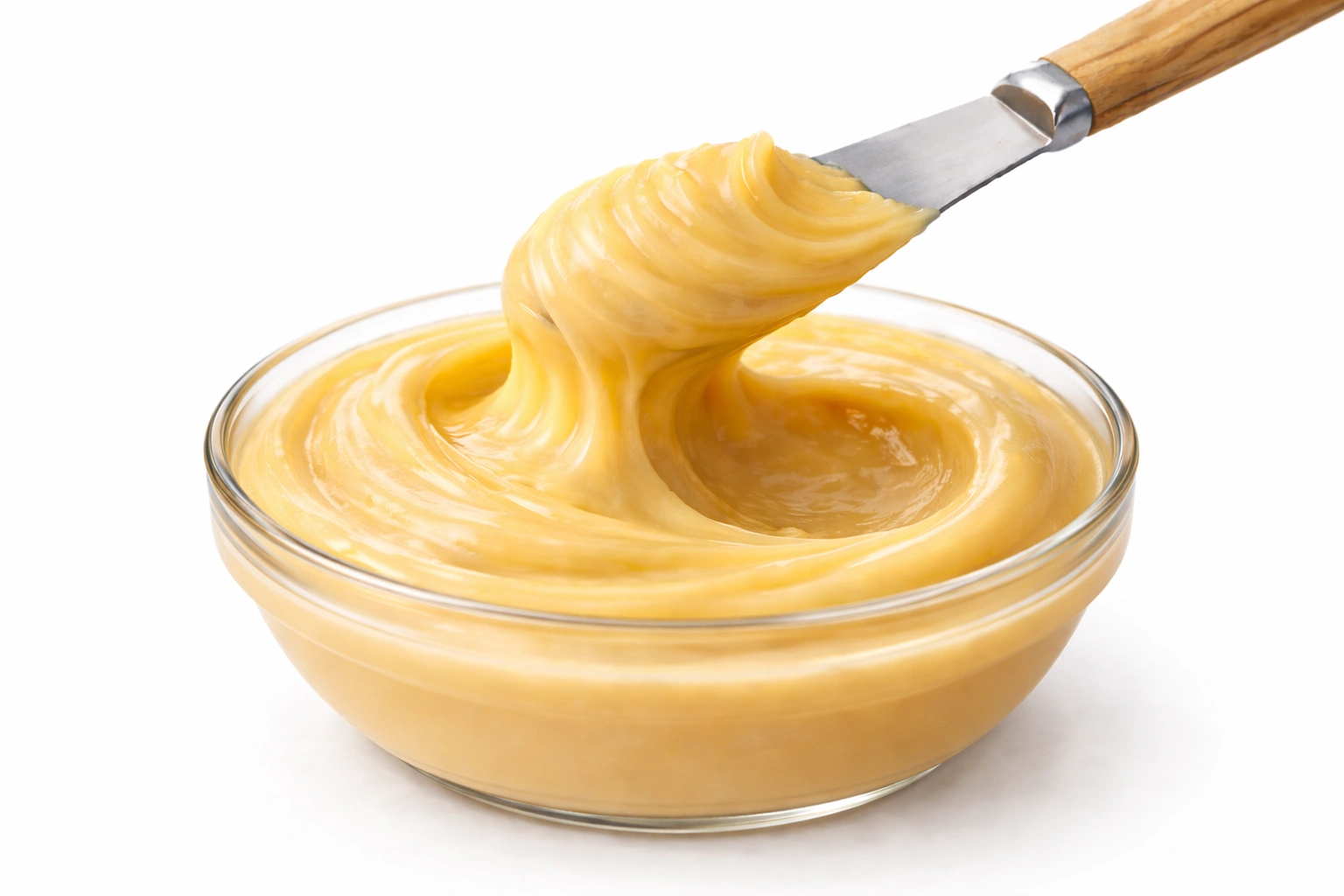
Creamed honey is 100% raw honey. Natural crystallization creates its smooth, spreadable texture. Gentle cold stirring preserves this stage so the honey does not become hard.
This content is educational. Honey is a food, not a medicine. We do not make health claims.
Author: Michal Blaško (MIJA Beekeeping).
Purpose: to explain creamed honey clearly, so readers understand that its smooth texture develops naturally during honey crystallization.
CEHZ: 382917
RVPS: 2058/2022
Creamed honey – what it means in practice
The smooth texture is not an artificial invention. Honey naturally passes through this stage as it crystallizes.
After extraction, floral honeys often change gradually in both appearance and texture: liquid → cloudy → creamy → hard-set. These are not four different kinds of honey, but the natural development of the same honey during crystallization.
The smooth texture is not artificially manufactured. Honey reaches the creamy stage naturally: it begins clear and liquid, then becomes cloudy, thickens and develops a fine, smooth structure.
If crystallization continues without intervention, the crystals grow and the honey progresses from a creamy texture into a firm state. This is why ordinary crystallized honey can eventually become very hard.
Creaming does not create the smooth texture from nothing. The creamy stage develops naturally. Gentle cold stirring simply preserves and stabilizes it, so the honey does not continue into a firm crystalline state.
- The smooth texture develops naturally – honey reaches this stage on its own during crystallization.
- Creaming prevents hard-setting – it keeps honey in its naturally smooth stage.
- Crystallization is normal – it is neither a defect nor proof of adulteration.
- No additives – the origin and basic composition of the honey remain unchanged.
Why is honey creamed?
Hard crystallized honey can be warmed and liquefied again. The purpose of creaming is to avoid that unnecessary cycle of repeated reheating.
If honey can be warmed back into a liquid, why cream it at all? The answer is not that creamed honey is “different” or automatically better. The point is that creaming keeps honey soft without repeated reheating.
Two options for floral honey
Most floral honeys naturally crystallize and eventually become firm. There are then two options: repeatedly warm the honey to make it liquid again, or preserve it in its naturally smooth stage before it fully hardens.
The second option is creaming. It is not an attempt to manufacture a “new” kind of honey, but a way to keep honey convenient to use without further liquefaction.
| Ordinary crystallized honey | Creamed honey |
|---|---|
| naturally becomes hard-set | remains smooth and creamy |
| must be warmed to return to liquid form | normally needs no liquefying for everyday use |
| may crystallize and harden again after liquefaction | stays soft and spreadable for a long time |
Liquid honey may look clearer, more attractive and “fresher”. That does not mean it is always more valuable. Creamed honey is made to remain convenient over time without unnecessary heat exposure, not merely to look more appealing.
Creamed and liquid honey can be the same honey at different physical stages. The main differences are texture, convenience and whether further heating is needed.
How the smooth stage is preserved
The final smoothness of creamed honey depends on the type of honey and on when gentle stirring begins. The earlier the forming crystals are managed, the finer the final texture can be.
For properly made creamed honey, the honey is stirred at low speed, often as soon as clear honey begins to lose its sparkle and develops a slight haze. The aim is not to whip or aerate it, but to manage the forming crystals before they grow into a coarse structure.
It is therefore more accurate to describe the process as gentle cold stirring rather than whipping. The mixer should work without drawing unnecessary air bubbles into the honey, keeping the final structure as fine as possible.
What happens to the crystals
During crystallization, glucose crystals form in honey. If they grow undisturbed, they can eventually create a hard or grainy texture.
The smoothness of creamed honey also depends on when stirring begins. If stirring begins at the first slight haze, the crystals have less time to grow. The result can be an exceptionally fine, smooth texture in which the crystals are barely noticeable when eaten.
Why not all creamed honey is equally smooth
The final smoothness also depends on the natural composition of the particular honey. Some floral honeys crystallize more finely, while others naturally tend to form coarser crystals.
This means that timing matters as much as stirring. For honey prone to coarse crystallization, stirring should begin early—at the first slight haze.
What is not added
Proper creaming adds no sugar, syrup, starch, thickeners, colours or preservatives. It is simply a way of managing honey’s natural crystallization.
What changes is mainly the size and arrangement of the crystals, not the origin or basic composition of the honey.
What creaming changes—and what it does not
Creaming does not turn honey into a different food. It only influences the course and final structure of its natural crystallization.
What changes is the size of the crystals, their uniformity and their distribution throughout the jar. A coarse crystalline structure is replaced by a fine, smooth one.
What does not change is the origin, basic composition or natural character of the honey. Creamed honey remains honey from the same batch, simply in a more convenient texture.
A creamy texture alone does not prove origin, quality or laboratory parameters. These are assessed through traceability: beekeeper → season → batch → evidence.
Why we avoid repeated reheating
Creamed honey remains easy to use without having to liquefy it later merely for appearance or fluidity.
When honey becomes completely hard-set, many people try to return it to liquid form by heating it. This is usually done for appearance and convenience, not for safety.
Because creaming does not require repeated heating, heat-sensitive honey enzymes are not exposed to unnecessary thermal stress.
Creaming is therefore a practical way to keep fast-crystallizing floral honeys soft without having to liquefy them again after they harden.
Liquidity is not proof of quality
Clear liquid honey may be its natural state after extraction or a characteristic of certain varieties, such as acacia honey. Liquidity alone does not prove quality.
Likewise, crystallization does not mean spoilage or adulteration. It is a natural physical process in honey.
Why creamed honey often looks lighter
A lighter appearance is not evidence of additives. It is often an optical effect caused by fine crystals.
Creamed honey contains many tiny crystals that scatter light, so the same honey can appear lighter, more opaque and creamier than it does in liquid form.
Colour is not proof of quality
Honey colour is influenced by botanical origin and physical structure. Lighter creamed honey is not necessarily “better”, and darker creamed honey is not necessarily worse.
What matters more than colour
Origin, season, batch, processing and the beekeeper’s transparency matter more when assessing honey. Colour is only one outward characteristic.
How to store creamed honey
Creamed honey is relatively stable, but it is affected by the same things as any honey: heat, light and moisture.
Do not store honey on a windowsill, beside a radiator or in direct sunlight. Prolonged heat can unnecessarily alter its properties and reduce the stability of its creamy texture.
Store it in a dark, dry place at a stable temperature. Keep the jar tightly closed because honey naturally absorbs moisture from the air.
- away from direct sunlight
- away from radiators and warm areas of the kitchen
- always tightly closed
- without unnecessary liquefaction merely for a liquid appearance
If a thinner layer appears on the surface
At higher temperatures, creamed honey may partially separate: a thinner liquid layer can appear on top while a denser layer remains below. This is not necessarily adulteration; it is often a response to warm storage.
A stable, cooler environment helps. If needed, stir gently with a clean spoon.
How to choose real honey: a simple trust filter
Honey texture matters for convenience, but trust is built mainly through origin, batch traceability and verifiable information.
Good honey has a specific beekeeper, location and season. Without these details, labels such as “local honey” are only general marketing phrases.
A batch code links the jar to a specific production batch. It is a simple sign that the beekeeper can trace which honey the jar contains.
When exceptional properties are claimed, exceptional transparency is only fair: batch + methodology + verifiable laboratory report.
FAQ: Creamed honey
Clear answers to the most common questions about creamed honey.
What is creamed honey?
Creamed honey is 100% raw honey that naturally develops a smooth, spreadable texture during crystallization. Gentle creaming preserves this natural stage and prevents the honey from progressing to a firm crystalline state.
Does the creamy texture come from the creaming process?
The creamy stage develops naturally during honey crystallization. Gentle cold stirring simply stabilizes it, so the honey does not continue into a firm crystalline state.
Why make creamed honey if hard crystallized honey can be liquefied?
Hard crystallized honey can be warmed and liquefied again, but creaming avoids that cycle: keeping the honey in its naturally smooth stage so it remains soft and spreadable without repeated heating merely to restore liquidity.
Is creamed honey whipped or aerated?
Proper creaming does not involve vigorous whipping or foaming. The honey is stirred slowly to avoid unnecessary aeration and the formation of air bubbles.
Does creamed honey contain additives?
No. Properly made creamed honey contains no added sugar, syrup, starch, thickeners or preservatives. What changes is mainly the size and distribution of the crystals, not the honey’s origin or basic composition.
Why is creamed honey convenient?
It remains soft and spreadable without repeated heating merely for appearance or liquidity. This reduces unnecessary heat exposure.
What determines how smooth creamed honey is?
Smoothness depends on the honey’s natural composition and on when stirring begins. If stirring begins at the first slight haze, the crystals have less time to grow and the final texture can be exceptionally fine.
Is creamed honey healthier than liquid honey?
Creamed and liquid honey can be the same honey in different physical states. The difference is mainly texture and convenience, not that one is automatically healthier.
Why can creamed honey cost more?
Creamed honey can cost more because it requires additional time and careful timing of crystallization, slow stirring and additional work by the beekeeper. A higher price alone does not prove quality; origin, batch traceability and transparency matter.
Can creamed honey be used in tea?
Yes. Creamed honey can be used in tea just like liquid honey. To limit heat exposure, do not add it to a boiling drink, but after it has cooled to a comfortable drinking temperature.
Is honey crystallization a defect or a sign of adulteration?
No. Crystallization is a natural physical process in honey. By itself, it is not evidence of adulteration or spoilage.
This website is educational. Honey is a food, not a medicine. We do not make health claims.
Sources and scientific background
Scientific sources on crystallization physics, finely crystallized honey and the effects of heat on honey quality parameters.
View sources
-
Physical properties of honey and crystallization:
NCBI (PMC) – physical properties of honey
Crystallization is associated with honey’s supersaturated sugar solution, particularly glucose, and is also influenced by temperature and storage. -
Honey composition and differences between varieties:
NCBI (PMC) – chemical composition of honey
Sugar ratios and natural composition influence both the rate and character of crystallization.
-
Classic method for finely crystallized honey:
Dyce, E.J. (1931) – Producing finely granulated honey.
Describes how fine crystal formation is controlled to create a smooth texture without changing the honey’s basic composition. -
Crystal growth mechanisms in honey:
Lupano, C.E. – Crystallization of honey (Food Research International).
Crystal size and uniformity are physical properties; managing crystallization changes the structure, not the origin of the honey.
-
International quality standard:
Codex Alimentarius – Standard for Honey (CXS 12-1981)
Defines honey quality indicators including HMF and diastase activity. -
Relationship between heat, time and quality:
NCBI (PMC) – HMF and enzyme activity
Higher temperatures and prolonged storage can alter honey quality parameters.
These sources provide scientific background on the physical properties and quality assessment of honey. Honey is a food, not a medicine; the mechanisms discussed concern physics, chemistry and processing technology.
Creamed honey direct from the beekeeper
When available, we offer creamed honey from our own apiary with a known origin, harvest season and traceable batch.
MIJA Beekeeping is a family apiary near Nitra, Slovakia. Our honey comes from our own apiary and is linked to a specific season and batch. We provide origin and key batch information transparently whenever available.
Creamed honey should not be an anonymous product with no traceable origin. The simplest trust filter remains the same: know the beekeeper, season, origin and batch.
Honey is sold through direct farm sales. Personal collection directly from the beekeeper is available by arrangement. Creamed honey availability varies by season and current stock.
- Slovak honey from our own apiary
- creamed honey subject to current availability
- traceable season and batch
- direct contact for orders or collection
Phone / WhatsApp: 0907 717 644
Email: vcielkamija@gmail.com
Collection: Čab near Nitra, Slovakia, by arrangement
Please check current availability before ordering. Not every honey batch is suitable or available for creaming throughout the season.